Gymnastics 101
How scoring and finals work in women’s artistic gymnastics. Five questions for your next competition.
Senior women’s artistic gymnastics · FIG rules 2025–2028. Final formats: Worlds 2026.
01How is a gymnastics score calculated?
The final score adds difficulty (D) and execution (E), then subtracts any separate penalties. E starts at 10.00; faults in technique, execution and, where applicable, artistry reduce it.
On bars, beam and floor, D combines credited difficulty, composition requirements, connections and bonuses. On vault, the vault performed has an assigned difficulty value. The final score is therefore not capped at 10.
In this invented example, 1.80 in E deductions leaves 8.20 for execution. A separate 0.10 penalty is then subtracted from D plus E. It is not another deduction from the E-score.
D + E − penalty = total
- Difficulty · D
- 5.600
- Execution · E
- 8.200
- Penalty
- −0.100
- Total
- 13.700
Watch the routine
 45s
45sRebeca Andrade · bars · Antwerp 2023
Source: World Gymnastics Channel · Rules of the time (2023)
02How can a gymnast win despite a fall?
Because the total score decides the ranking. A fall normally costs 1.00 in execution under the current rules. Higher credited difficulty can still outweigh that loss when two routines are compared.
A fall can also affect credited skills or connections; other execution faults still count. This is not a guarantee that the harder routine will win.
In our fictional comparison, A’s E-score already includes the fall. Her 13.800 narrowly beats B’s 13.700. Do not subtract another point from A’s total: that would count the same fall twice. Neither routine has a separate penalty in this example.
| Gymnast | D | E | Total |
|---|---|---|---|
| A with a fall | 6.200 | 7.600 | 13.800 |
| B without a fall | 5.200 | 8.500 | 13.700 |
The fall is already included in E. No separate penalties.
Watch the routine
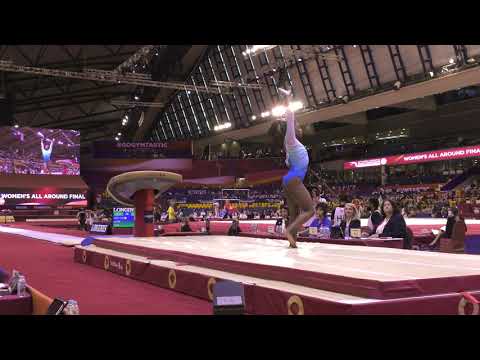 31s
31sSimone Biles · vault · Doha 2018
Source: USA Gymnastics · Rules of the time (2018)
03What is the difference between all-around, team and apparatus finals?
In the all-around, one gymnast adds her scores on all four apparatus: vault, bars, beam and floor. An apparatus final awards the title on one apparatus; vault requires two vaults.
The team final is a shared result. At Worlds 2026, three gymnasts compete on each apparatus for each team, and all three scores count. A team member does not have to perform on every apparatus.
Qualification determines who reaches these finals. Its scores do not carry over into the finals at these Worlds. A strong qualifying total earns a place, not a head start in the medal competition.
One gymnast: add all four apparatus.
VTUBBBFXWorlds 2026: three gymnasts on each apparatus; every score counts.
One apparatus; on vault, two vaults.
Watch the routine
 117s
117sRebeca Andrade · team-final floor · Antwerp 2023
Source: Time Brasil TV · Rules of the time (2023)
04Why can a highly ranked gymnast miss a final?
A high qualifying score is not always enough. At Worlds 2026, the all-around final has 24 places and each apparatus final has eight. Both allow at most two gymnasts per national federation.
A federation’s third gymnast can therefore miss a final despite outscoring someone who advances. Her routine has not been marked down afterwards: the restriction applies to final places.
Our invented excerpt shows four gymnasts within the top eight of apparatus qualification. X’s third gymnast is excluded by the two-per-federation limit. Y has not reached that limit in this excerpt. This is a selection illustration, not an actual result.
Fictional excerpt: four gymnasts inside an apparatus top eight.
| Gymnast | Score | Final eligibility |
|---|---|---|
| X1 | 14.300 | Eligible |
| X2 | 14.200 | Eligible |
| X3 | 14.100 | Excluded: two-per-federation |
| Y1 | 14.000 | Eligible |
X and Y represent two different federations.
Watch the routine
 51s
51sRiley McCusker · qualifying bars · Doha 2018
Source: USA Gymnastics · Rules of the time (2018)
05Why do some gymnasts perform two vaults?
The first vault counts for the team and all-around. A gymnast seeking a vault-final place must perform two vaults in qualification. Two are also required in the vault final, and they must belong to different vault groups.
The apparatus result starts with their average, not just the better attempt. A 0.20 bonus can apply when both vaults are completed without a fall and their saltos travel in different directions in the second flight, as defined by the Code.
Our fictional calculation deliberately has no vault bonus. Here, the same gymnast has 14.000 for team or all-around purposes, but 13.800 for vault qualification.
- Vault 1
- 14.000
- Vault 2
- 13.600
(14.000 + 13.600) ÷ 2
- For team and all-around
- 14.000
- For vault qualification
- 13.800
Example without a vault bonus.
Watch the routine
 29s
29sSimone Biles · vault 1 · Doha 2018
Source: USA Gymnastics · Rules of the time (2018)
Watch the routine
 34s
34sSimone Biles · vault 2 · Doha 2018
Source: USA Gymnastics · Rules of the time (2018)